Transformers: Age of Extinction offers plenty of reasons to simply watch things transform.
Lockdown turning into a gray Lamborghini Aventador LP 700-4 is an obvious example. The vehicle looks sleek and cold, and the transformation is undeniably cool. At the same time, there is still something slightly comic about the basic idea of a giant robot turning itself into a sports car. That strange combination has always been part of the appeal of Transformers. The franchise began around transforming action figures in the 1980s, with comics and animation developing around them, and the live-action movies have taken that toy-like idea and turned it into enormous CGI spectacle.
This movie also introduces a different-looking kind of transformation through KSI’s artificial Transformers. Galvatron and the other human-made machines do not simply rearrange mechanical parts like the Autobots. They break apart into Transformium particles and reconstruct themselves, even shifting around obstacles while transforming. It gives their movement a noticeably different look.
Then there are the Dinobots, with Transformers taking the forms of creatures such as a Spinosaurus, Pteranodon, and Triceratops. Add cars, trucks, helicopters, and all the other machines, and the transformations alone provide plenty to watch.
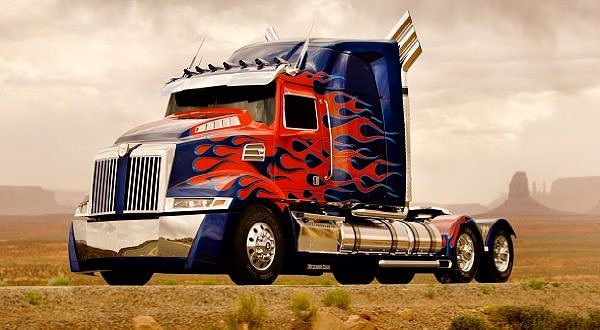
Optimus Prime gets a particularly satisfying moment.
Early in the movie, he is badly damaged and hiding from humans in the form of an old, battered truck. Cade Yeager discovers him and begins repairing him. Later, while they are escaping, Optimus scans a newer truck on the road and takes on a fresh vehicle form.
After seeing him in such a miserable condition, watching him suddenly return in that new form is quite a sight.
But the robots are only one part of the movie.
Take them out of the discussion for a moment. Put aside the CIA operation and the other enemies as well. Among the human characters, one of the most entertaining conflicts involves three people: Cade, his daughter Tessa, and Tessa’s boyfriend Shane.
The way the movie develops and resolves this conflict is, overall, reasonably satisfying.
Cade does not want Tessa dating before graduation. Tessa, naturally, does not understand why her father should have the right to make that decision for her.
The situation becomes more amusing because Cade himself became a father when he was very young. The movie establishes that Tessa was already part of his life around the time of his own high-school graduation. Cade can therefore look back and wish that he had been older and wiser, while Tessa can look at the same history and wonder what exactly that means for her.
Cade clearly treasures his daughter. At the same time, he does not want her repeating the choices he made when he was young.
From a parent’s position, that is understandable.
From Tessa’s position, it can sound rather strange.
Her father can regard having her as one of the greatest things that happened to him while also telling her that she should avoid the kind of relationship that led to her being born. The contradiction is difficult to ignore.
So what would satisfy Cade?
Perhaps Tessa can have male friends but should not date them.
That sounds simple until the obvious question appears: where does friendship end and romance begin?
Cade does not seem especially interested in giving Shane the benefit of the doubt.
Shane, unfortunately, does not always choose the best way to change Cade’s mind.
When Cade discovers the relationship, Shane brings up the Texas law that he says makes his relationship with seventeen-year-old Tessa legal. Whatever the legal argument may be, explaining the law to an angry father is not necessarily the fastest way to make that father think, “This seems like a good young man.”
If Shane wants Cade’s trust, legality alone is not really the issue.
Then comes the mouthwash.
Shane gets mouthwash because he intends to kiss Tessa. Cade is there to see it.
The mouthwash soon goes flying.
Shane really could have chosen a better moment.
If a young man is trying to make a good impression on the father of the girl he is dating — perhaps even a future father-in-law — openly preparing to kiss the man’s daughter is probably not the strongest strategy.
A much more effective approach would be to appear responsible, decent, and trustworthy from the beginning. Shane needs Cade to reach the conclusion that he is a good person for Tessa. Quoting the law and producing mouthwash do not exactly speed up that process.
The strange thing is that an alien war eventually helps him more than either of those attempts.
As Cade, Tessa, and Shane go through one dangerous situation after another, Cade gets to see Shane differently. Shane is not fearless; at one point, surrendering to the aliens seems like a perfectly reasonable idea to him. Still, the two men survive the ordeal together, and Cade gradually begins to trust him.
Later, Cade is willing to rely on Shane to look after Tessa while Cade goes back into danger himself.
That is more meaningful than a simple announcement that the relationship has been approved. Cade has spent enough time with Shane to decide that the young man may actually be dependable.
It is a familiar Hollywood pattern: people who do not like each other go through danger together and gradually build trust. Still, Shane might have made the process considerably easier for himself by starting with a more respectable first impression.
There is also Joshua Joyce, another inventor in a movie that already has Cade constantly trying to build things. Joshua operates on an entirely different level, using Transformium to manufacture Transformers themselves. His creations become part of another conflict in the film, particularly through Galvatron.
That storyline, the CIA operation, the Autobots, Lockdown, the Dinobots, and all the enormous action sequences give Age of Extinction several different threads at once.
But to me, the Cade–Tessa–Shane situation feels like the movie’s real theme, and it has its own kind of entertainment.
Cade is trying to protect his daughter. Tessa cannot fully accept the logic behind his restrictions. Shane wants Cade to trust him but does not always make decisions that help his case.
And the mouthwash was definitely a bad move.