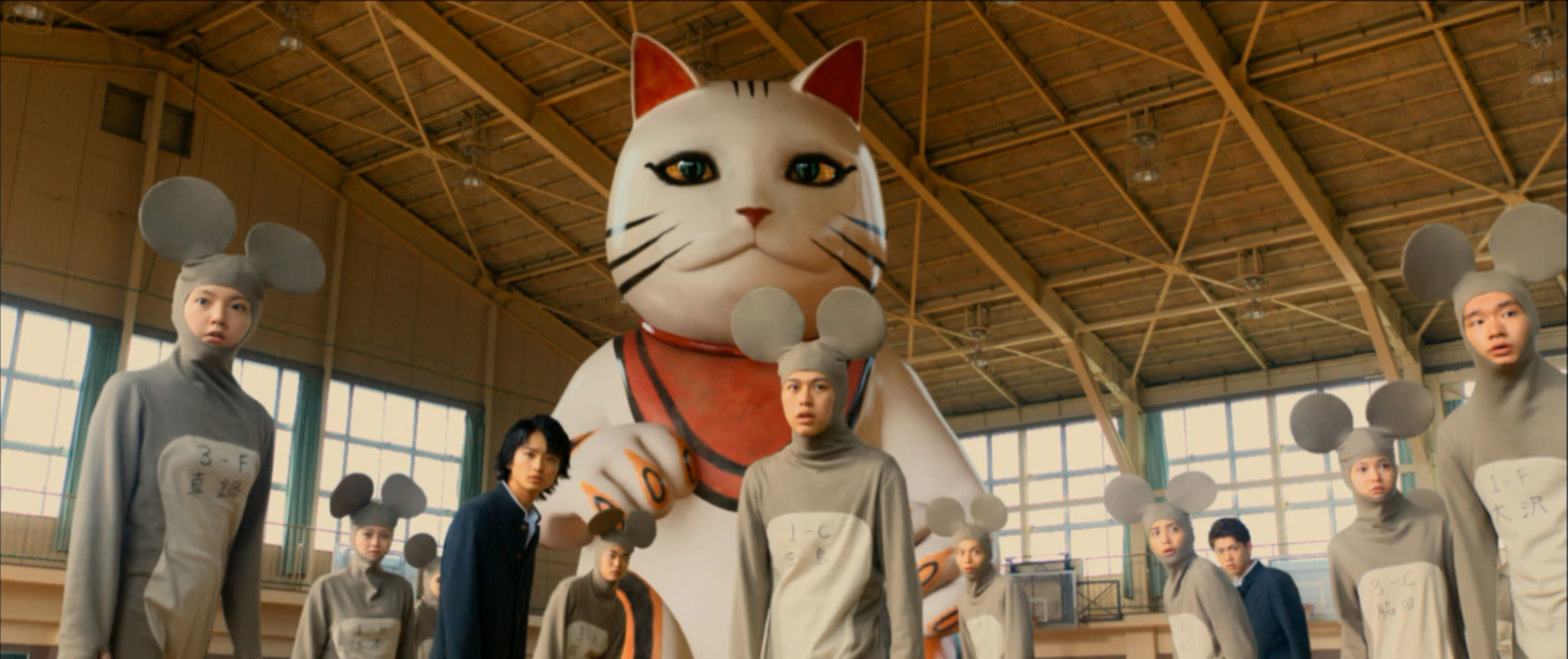
Takashi Miike’s As the Gods Will throws high school student Shun Takahata and his classmates into a succession of deadly games modeled on familiar children’s play. The games keep coming while their purpose—and whoever or whatever stands behind them—remains unclear.
That premise raises an interesting question: why do stories like this so often choose the young?
Youth is easy to romanticize from a distance. People who have grown older tend to look back on it as a period of energy, possibility, and physical strength. Yet those who are actually young rarely experience every day as some golden age. Adolescence can feel ordinary, confused, frustrating, and incomplete.
The irony is that youth often becomes precious only after it has begun to disappear.
A death game makes unusually effective use of that irony.
Teenagers are physically capable enough to run, react, struggle, and endure, but physical ability alone cannot explain their appeal as protagonists. If the point were simply to select contestants in peak physical condition, people in their early twenties might make even more sense.
What distinguishes adolescence is that these characters are still unfinished.
They are still becoming people.
That changes the meaning of their deaths. When someone this young disappears, the tragedy is not only the loss of the life that already existed. It is also the disappearance of everything that might have followed: relationships, careers, mistakes, recoveries, disappointments, successes, and all the ordinary years that had not yet been lived.
Perhaps that is part of why immature characters can make a death game especially cruel.
Ordinary adolescence provides time to make mistakes. A foolish decision, an embarrassing failure, or a wrong choice can become part of growing up. A death game destroys that privilege. The characters are still learning who they are, yet every decision can suddenly carry an absolute consequence.
Growing up is compressed into survival.
This also gives the violence of As the Gods Will a peculiar contrast. The movie surrounds its students with imagery drawn from childhood play: a Daruma doll, a giant lucky cat, and other seemingly playful creatures and games become instruments of terror.
Something that should belong to childhood becomes lethal.
Then there are the gods—or, more cautiously, the forces that appear to stand above the players.
The original reflection on the film describes them as godlike beings that feel more like devils. That impression fits one of the film’s most unsettling tensions. Extraordinary power does not necessarily imply wisdom, justice, or goodness.
A being may possess power far beyond anything human beings can resist and still behave with horrifying cruelty.
From the victims’ perspective, the distinction between a god and a demon can therefore become strangely unstable. If an overwhelmingly powerful being treats human lives as pieces in a game, calling that being divine does little to make its behavior feel sacred.
Perhaps that contradiction is part of what makes the film’s use of childhood imagery so effective.
The games may look ridiculous. The objects may appear playful. The rules may sometimes resemble the sort of thing children might understand immediately.
The consequences are death.
That gap between appearance and consequence gives the film much of its grotesque humor. It does not need solemn monsters or majestic supernatural beings to create horror. Something childish can become terrifying simply because the power controlling it does not care what happens to the people forced to play.
And then there is luck.
The original response to the ending was struck by what it perceived as a strange idea: that luck itself begins to resemble another form of ability. Whether or not luck deserves to be called a skill, it becomes difficult to ignore in a survival game built around arbitrary rules.
Skill is normally something that can be developed. Judgment can improve. Strength can be trained. Experience can accumulate.
Luck is different.
Yet once survival becomes the only result that matters, the distinction can become brutally unstable. Someone may survive partly because of intelligence or courage and partly because circumstances happened to fall in the right direction.
Afterward, survival itself can begin to look like evidence of deserving to survive.
That is an unpleasantly circular idea.
The survivor is the winner because the survivor survived, even when parts of the process were never under anyone’s control.
This makes As the Gods Will more interesting than a simple collection of elaborate death games. Its characters struggle as though effort, intelligence, and determination must matter, while the larger structure continually reminds them that they do not control the world in which those qualities are being tested.
The official synopsis itself leaves the purpose of the games and the identity of whoever is behind them unresolved.
That uncertainty suits the film.
The original reflection was also struck by the strange final human figure associated with the idea of “God”—hardly the magnificent divine presence one might expect, but someone who appeared almost like a shabby old wanderer. Rather than treating that impression as an objective explanation of the film’s mythology, it works better as one final piece of its absurdity.
After everything that has happened, why should the answer suddenly become dignified?
As the Gods Will is a film where childhood games become massacres, youth becomes material for a spectacle, apparently godlike power can feel demonic, and even luck begins to look like another qualification for survival.
In a world like that, perhaps the strangest thing would be if God looked respectable.