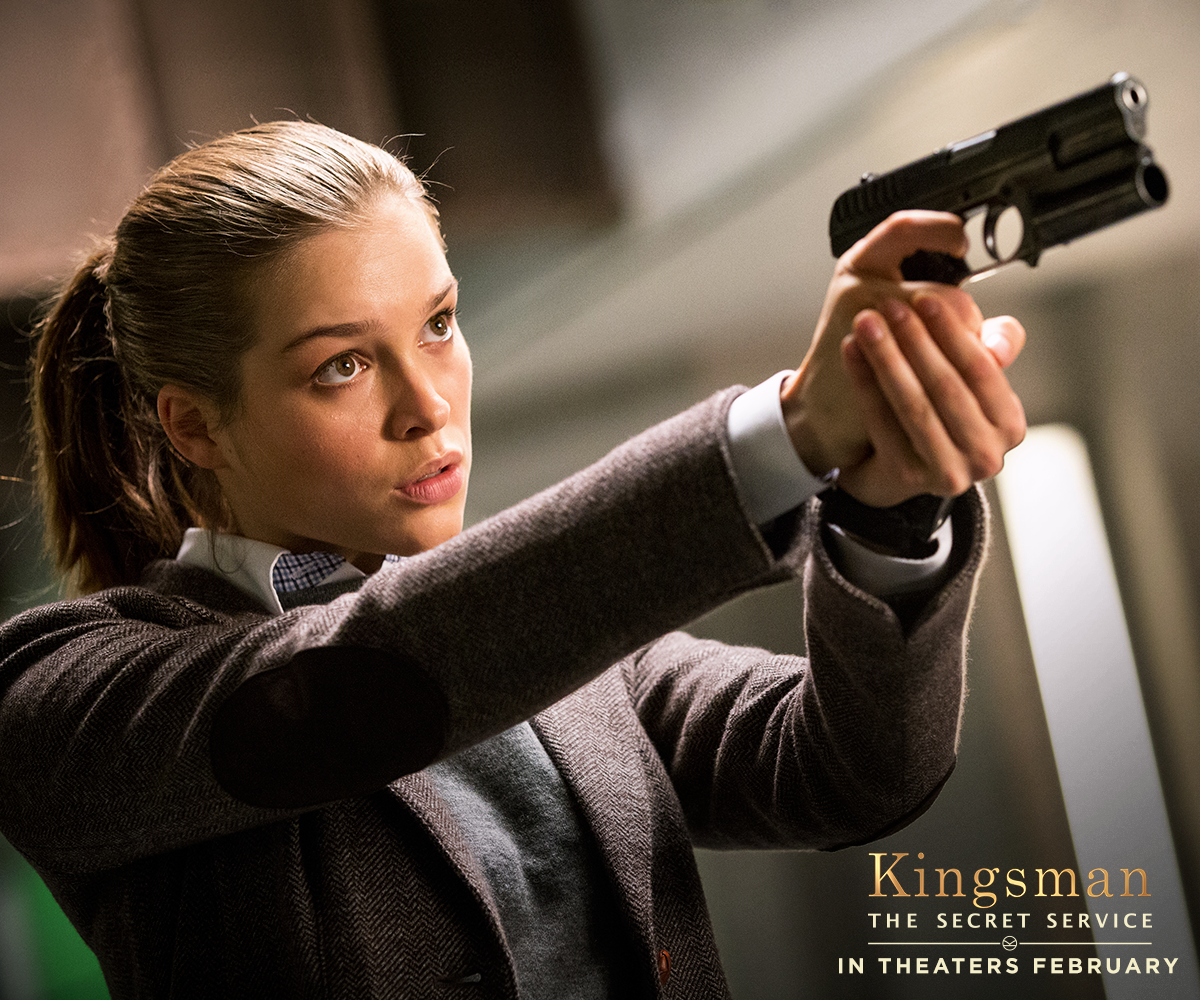
Kingsman: The Secret Service (2015): When Manners Become a Weapon
By the time Kingsman: The Secret Service arrived, the modern spy movie had already spent decades trying to decide what to do with James Bond.
Bond was too influential to ignore but too familiar simply to imitate. One solution was to modernize him. Another was to reject the tuxedo, polished manners, and old-fashioned sophistication altogether. The 2002 Vin Diesel vehicle xXx, for example, imagined a younger and rougher kind of secret agent built around the persona of an extreme-sports outlaw.
Kingsman, however, takes almost the opposite route. Instead of throwing away the gentleman, it exaggerates him.
That is what gives the film its distinctive character. Kingsman knows that Bond exists and constantly plays with the audience’s knowledge of spy-movie conventions, but it does not feel like a simple attempt to renovate 007. Tailored suits become armor. Formal manners become a code of conduct. A respectable tailor’s shop conceals an intelligence organization. Even the umbrella, perhaps the most ordinary accessory imaginable in a rainy British city, becomes both shield and weapon.
The result is a spy fantasy that can somehow feel even more aggressively British than James Bond.
More Than a Bond Update
The Bond series had already reinvented itself repeatedly long before Kingsman. Different actors and different eras changed the tone without destroying the character’s basic identity. Kingsman has no such history to preserve, which gives it the freedom to take the old gentleman-spy image and push it almost into caricature.
Its characters do not merely wear suits because spies traditionally wear suits. The suit belongs to an entire ideal built around clothing, posture, vocabulary, education, self-control, and manners.
That is why “Manners maketh man” matters beyond being a memorable slogan.
Eggsy does not come from the social world that appears naturally suited to Kingsman, yet the film allows him to grow into it. Gentlemanliness is presented less as an inherited status than as something demonstrated through conduct, discipline, and ability.
But Kingsman is hardly a quiet drama about class or etiquette. Almost every civilized value it introduces eventually becomes an excuse for spectacular violence. That contradiction is one of the film’s central pleasures.
The Umbrella, the Gentleman, and British Violence
The umbrella may be the perfect Kingsman object.
At the simplest level, it evokes Britain: grey skies, formal clothing, London streets, and the image of a well-dressed man prepared for bad weather. British screen culture had also long associated the umbrella with the gentleman action hero, most famously through John Steed in The Avengers.
Kingsman takes that familiar symbol and weaponizes it without destroying its elegance.
Harry Hart can look perfectly composed while carrying an object capable of functioning as protection, firearm, and technological gadget. The appearance remains civilized while the function underneath it is violent. That mixture captures the film in miniature.
The same tension defines Colin Firth’s performance. Harry speaks softly, dresses impeccably, and treats manners almost as a moral discipline. Then the film places him inside some of its most ferocious action sequences.
The pub confrontation built around “Manners maketh man” works precisely because the violence arrives from someone who appears so controlled. The film does not abandon the gentleman when the fighting begins. Instead, it turns lethal competence into part of the gentleman fantasy.
The church sequence pushes that contradiction much further. Elegance gives way to frenzy, yet the choreography still retains an almost unnerving precision. The thrill comes partly from seeing restraint transformed into devastating action.
This is not gentlemanly violence in any realistic sense. It is gentlemanliness converted into action-movie charisma.
Guns as Choreography
The film’s gunfights also raise an interesting question: where did this increasingly physical style of firearm combat come from?
There is no simple answer.
Hong Kong action cinema had already been transforming gunplay into choreography during the 1980s and 1990s, particularly through filmmakers such as John Woo. Equilibrium later made the idea unusually explicit with its fictional Gun Kata, turning firearms into part of a martial-arts-like system of bodily movement.
The Man from Nowhere belongs to a later generation of hard-edged action cinema in which guns, knives, grappling, and close-range violence occupy the same physical space. Then John Wick pushed the fusion of firearms and close-quarters fighting even further, making shooting part of continuous physical exchanges involving movement, holds, throws, and rapid changes of range.
It would therefore be misleading to identify any one of these films as the single origin of modern gun-fu.
What matters more for Kingsman is that it inherits a long cinematic tendency to make shooting physical rather than merely ballistic. Its gunplay is not just about aiming and firing. Bodies move through the action, and firearms become part of the choreography.
Whether those movements resemble Systema, military combatives, or some other real-world fighting method is ultimately less important than their cinematic effect.
Kingsman wants violence to look good, and it succeeds.
Violence as Celebration
The film eventually reaches a point where excess no longer needs justification.
Its climax, in which heads explode in a brightly colored sequence staged almost like fireworks, is perhaps the clearest declaration of what kind of movie this has become. The deaths are grotesque, but their presentation is deliberately festive. Violence has crossed so far beyond realism that destruction itself becomes visual spectacle.
The scene could easily have become merely disgusting. Instead, its flamboyance almost transforms gore into decoration.
That attitude extends to the film’s treatment of spy-movie conventions in general. Kingsman knows perfectly well how absurd its villains, gadgets, secret bases, heroic escapes, and elaborate conspiracies are. It does not apologize for the absurdity. Awareness of the cliché becomes permission to push it even further.
Even the final sexual joke follows that logic.
Bond movies traditionally allowed seduction to function as one of the hero’s rewards after saving the world. Kingsman takes that familiar convention and makes it deliberately cruder and more explicit. Whether the joke works is another matter. It is one of the places where the film’s playful vulgarity comes closest to simple adolescent humor.
But it is consistent with everything around it.
The film keeps taking elements associated with classic spy elegance and asking how far they can be distorted without losing their recognizable shape.
A Gentleman Spy Who Refuses to Behave
That may be the central pleasure of Kingsman: The Secret Service.
It is fascinated by manners but refuses to behave itself.
The film admires tailored suits, disciplined speech, formal etiquette, old-fashioned accessories, and the fantasy of the British gentleman. Then it fills that elegant world with close-range gunfire, brutal fights, exploding heads, vulgar jokes, and violence of almost comic-book intensity.
The two sides do not cancel each other out. They create the movie.
A conventional modernization of the spy genre might have thrown away the gentleman because he seemed outdated. Kingsman makes the more entertaining choice. It keeps the gentleman, gives him an umbrella, teaches him how to kill a room full of people, and makes absolutely sure that his suit still looks immaculate afterward.
“Manners maketh man,” Harry says.
Kingsman adds an unspoken qualification:
manners and mayhem are apparently allowed to coexist.