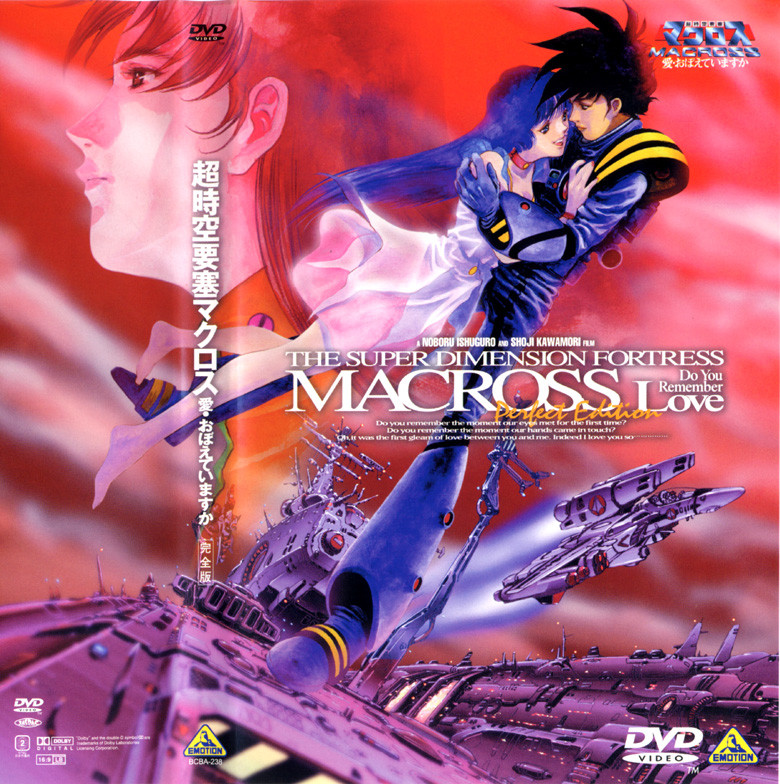
Macross: Do You Remember Love? was released in Japan in 1984 as a theatrical reconstruction of the original Super Dimension Fortress Macross television story. It is not a digital production, despite how easily it can be mistaken for one when revisited today. The film was created in the era of hand-drawn theatrical animation and preserved on 35mm film, which later allowed it to be scanned and restored in 4K. More important than the restoration, however, is how little resistance the film’s original imagery creates. The detailed machines, crowded space battles, character animation, and enormous sense of scale do not feel like obstacles that must be forgiven because of the film’s age.
The story places idol singer Lynn Minmay, Valkyrie pilot Hikaru Ichijyo, and officer Misa Hayase inside a war between humanity and alien forces. Minmay’s concert is interrupted by an attack, Hikaru rescues her, and a relationship develops while his initially hostile connection with Misa also begins to change. The movie moves between transforming fighters, military conflict, romance, and popular music without treating them as separate attractions. A song is not merely background decoration here. “Do You Remember Love?” eventually becomes part of the struggle itself, carrying remnants of an ancient culture into a battle that has almost forgotten what culture is.
That combination may explain why this particular kind of older science fiction remains so easy to revisit. The technology on screen belongs unmistakably to an earlier imagination of the future, but the film does not depend on predicting the future correctly. Its spaceships and transforming aircraft are tied to emotions, memories, and songs that the characters themselves are in danger of losing. The machinery may be enormous, yet the question running beneath it is small enough to follow a viewer long after the battles have ended.
The title also changes as time passes. At one point, “Do you remember love?” may sound like a question that deserves an immediate and confident answer. Years later, that confidence may no longer come so easily. Nothing dramatic has to replace it. The memory may simply become less distinct, as though something once familiar has moved farther away without completely disappearing. The film can remain vivid even while the answer attached to its title becomes uncertain.
Rewatching the film does not necessarily restore that answer. It may only make the title feel more personal than it did before. For a movie filled with giant machines, alien warfare, an idol concert, and a song capable of interrupting destruction, that lingering uncertainty is an unexpectedly human place to end.