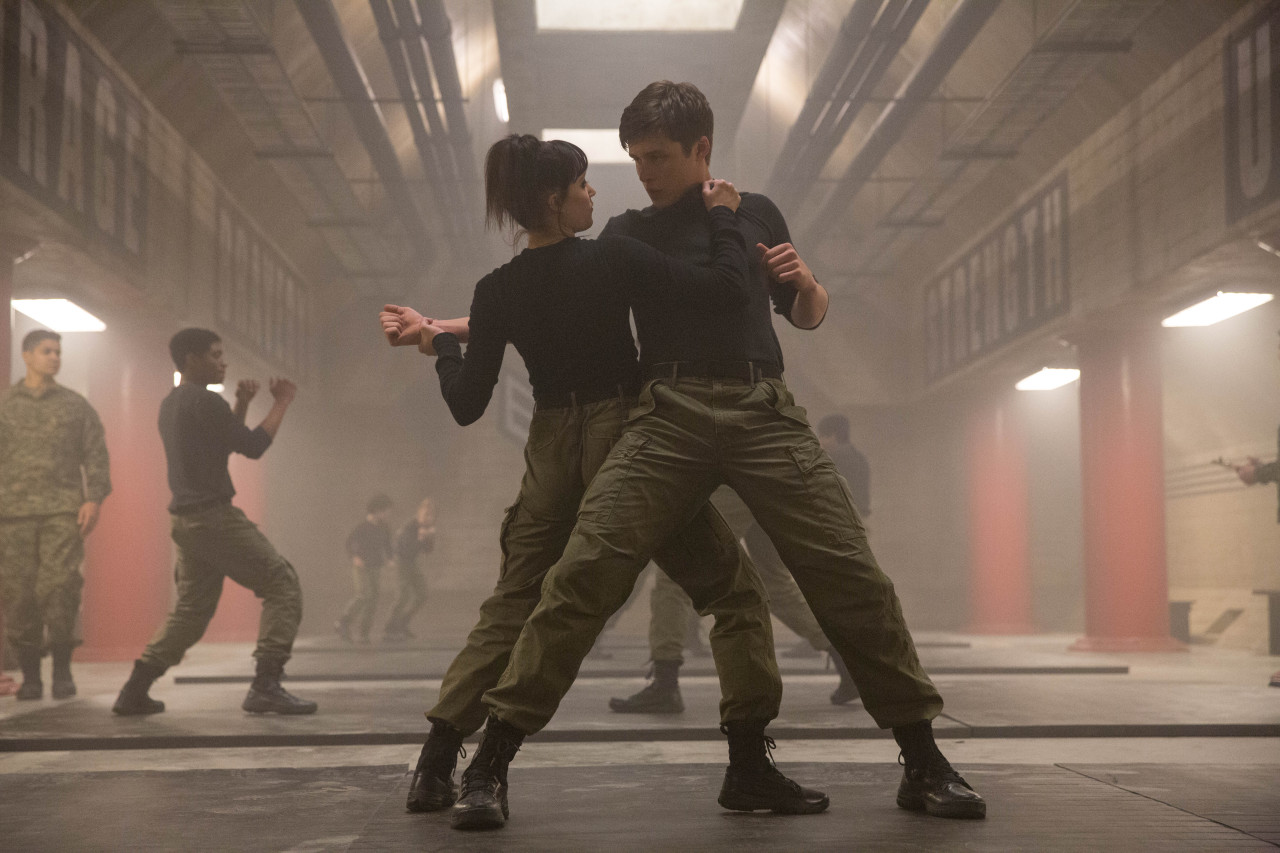
One of the most striking things about The 5th Wave is simply seeing Chloë Grace Moretz at the center of it.
For many viewers, Moretz first became unforgettable as Hit-Girl in Kick-Ass. She was only thirteen when that film arrived in 2010, and her age was a major part of the character’s impact. Hit-Girl looked like a child but fought, swore, and killed with an outrageous confidence that made her seem as if she had wandered in from an even wilder movie.
Six years later, The 5th Wave presents Moretz very differently. She is no longer the startling child performer who steals scenes from older actors. She is the star expected to carry a large-scale science-fiction survival story.
The change is immediately noticeable.
Moretz plays Cassie Sullivan, a sixteen-year-old whose ordinary life disappears after Earth is devastated by successive waves of alien attacks. Civilization collapses, her family is torn apart, and Cassie is left trying to reach her younger brother while confronting an increasingly dangerous problem: the enemy may no longer be recognizable as the enemy.
That premise gives The 5th Wave its most interesting idea.
The destruction of cities and infrastructure is familiar material for an alien-invasion movie. Distrust is more interesting. If another person may not actually be human, then survival depends not only on fighting or escaping but on deciding whom to believe.
Moretz is well suited to that tension, especially when viewed against the memory of Hit-Girl.
In Kick-Ass, her youth made violence surprising because Mindy Macready behaved almost nothing like the child she appeared to be. Cassie works in the opposite direction. She begins as someone recognizably ordinary and is forced toward violence by circumstances. The point is no longer that a little girl can be terrifying. The question is whether an ordinary teenager can adapt quickly enough to survive when everything familiar has disappeared.
That makes the passage from Hit-Girl to Cassie more than a simple reminder that an actress has grown older.
The roles represent almost opposite uses of youth.
Hit-Girl enters Kick-Ass already formed. She has the skills, confidence, and ruthlessness that everyone else lacks. Cassie begins The 5th Wave without those advantages. Her story depends on fear, uncertainty, separation, and gradual adaptation.
Moretz has enough presence to make that transition credible. She can look frightened without making Cassie passive, and she can become tougher without suddenly turning her into another Hit-Girl.
The difficulty is that the movie around her is less distinctive than the transformation she is being asked to make.
The 5th Wave arrived during a period when young-adult dystopian adaptations had become extremely familiar. Teenage protagonists, ruined societies, militarized institutions, hidden agendas, romance, and uncertainty about authority were already recognizable genre ingredients. The film therefore has an intriguing science-fiction premise but often channels it through conventions that no longer feel especially new.
That matters because the central idea deserves more room.
An invasion in which distrust itself becomes a weapon could produce a deeply paranoid story. Anyone encountered on the road might be dangerous. Military authority might not mean safety. Even apparent humanity might become unreliable.
The film touches that anxiety repeatedly, but it also has to keep moving through the machinery of a YA franchise story.
This is where Moretz becomes more interesting than the genre surrounding her.
Watching The 5th Wave after Kick-Ass creates an unusual sense of elapsed time. The small, shocking Hit-Girl has become the conventional center of a studio science-fiction film. Moretz no longer needs the novelty of being a child who behaves like an adult action hero. She now has to hold the story together in a much more traditional leading role.
And she largely can.
There is something slightly ironic about that.
The 5th Wave is a movie about adolescence being violently interrupted by catastrophe. At the same time, it catches one of its stars at the point where audiences who remember her as a child actor can clearly see that childhood has ended.
The actress has grown into the leading role.
The genre around her does not always seem to have grown quite as far.